


DEMOCRACY UNFILTERED: WHAT TRUE DEMOCRACY REQUIRES?
- Adveline Minja
- May 29
- 3 min read
By Nia N. Kileo | Wisdom Thrives Media | May 28th, 2026
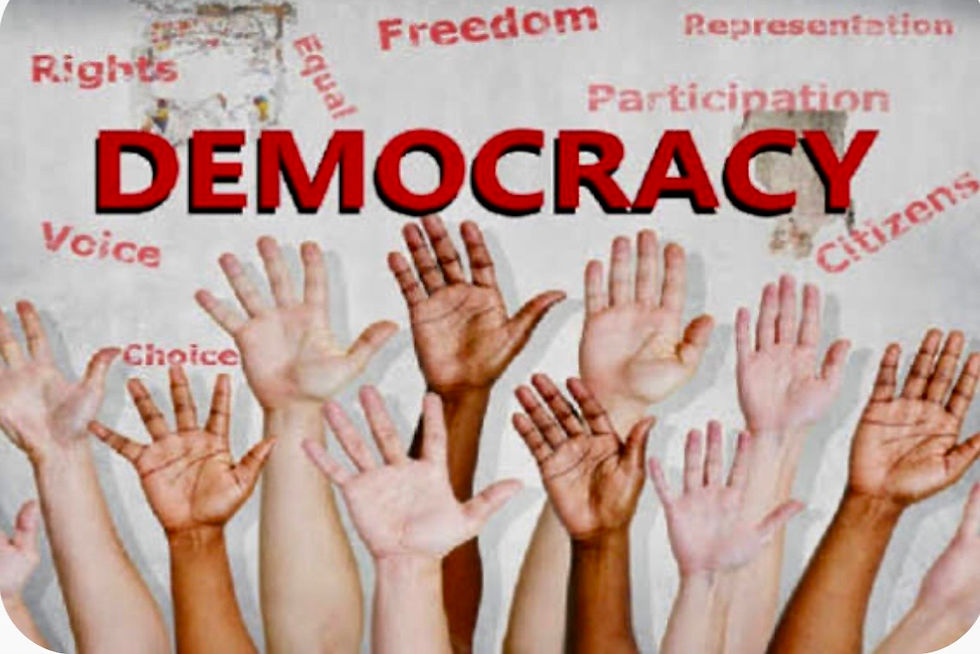
The world’s oldest and largest democracies are often presented as models of democratic governance. Yet recent years have revealed an uncomfortable reality: democracy’s greatest threats do not always come from military coups or the outright suspension of elections. Sometimes they emerge gradually through institutional weakness, political polarization, declining public trust, and the concentration of power.
The United States and India are frequently cited as democratic success stories because of their history, scale, and constitutional foundations. Yet both have faced growing scrutiny over the health of their democratic institutions.
The challenge is not whether these countries remain democracies. The deeper question is whether democratic systems continue to function as intended: serving the people rather than political interests, protecting institutions rather than personalities, and strengthening accountability rather than concentrating power.
Democracy is often measured through elections. But elections alone do not guarantee democratic governance.
A nation may hold regular elections while still struggling with declining trust in public institutions, weakened checks and balances, restrictions on dissent, media pressures, political polarization, or unequal access to justice. These realities remind us that democracy is not a destination that a nation reaches once and for all. It is a continuous practice that requires vigilance, participation, and institutional integrity.
What True Democracy is?
“True democracy exists when all branches of government and its institutions serve the people and the nation—not just the president, a single branch, or a single party.”
This principle lies at the heart of democratic governance.
The executive, legislature, judiciary, independent commissions, media, civil society, and citizens each have a role to play. When one branch dominates the others, when institutions exist primarily to protect political leaders, or when loyalty becomes more important than accountability, democracy begins to weaken.
Democracy was never designed to serve individuals. It was designed to serve the public interest.
The Responsibility of Citizens
Democratic decline is not solely the responsibility of governments or political leaders.
Citizens also play a role.
When people disengage from public affairs, ignore misconduct, excuse abuses because they support a particular party, or view governance as someone else’s responsibility, democratic institutions become vulnerable.
Democracy depends on active citizenship.
Voting matters. Civic participation matters. Independent institutions matter. Constructive criticism matters. Accountability matters.
The phrase “We the People” is not merely symbolic. It reflects the idea that citizens are not spectators of government; they are participants in it.
A Lesson Beyond The United States and India
The conversation extends far beyond any single country.
Whether in established democracies, emerging democracies, or nations still strengthening
their institutions, the same principle applies:
A healthy democracy is not measured by the popularity of a leader, the dominance of a party, or the frequency of elections alone.
It is measured by whether institutions remain accountable, whether laws apply equally, whether citizens can freely participate, and whether government serves the nation rather than itself.
True democracy is not about who holds power.
It is about whether power remains accountable to the people.
“Democracy is strongest when institutions serve the nation, leaders respect limits, and citizens refuse to become bystanders.”
WTM | Civic Education & Democratic Governance


Being relative in practical sense I do not know we can truly have democracy since every nation uses this terminology to fit its context.