


United Africa, Open Africa, Stronger Africa: Why African Unity Must Move Beyond Speeches and Borders!
- Adveline Minja

- May 27
- 5 min read
By Mussa Shehe, Country Coordinator, Sanze Connect, with Editorial Contributions by Nia N. Kileo | Wisdom Thrives Media | May 26, 2026
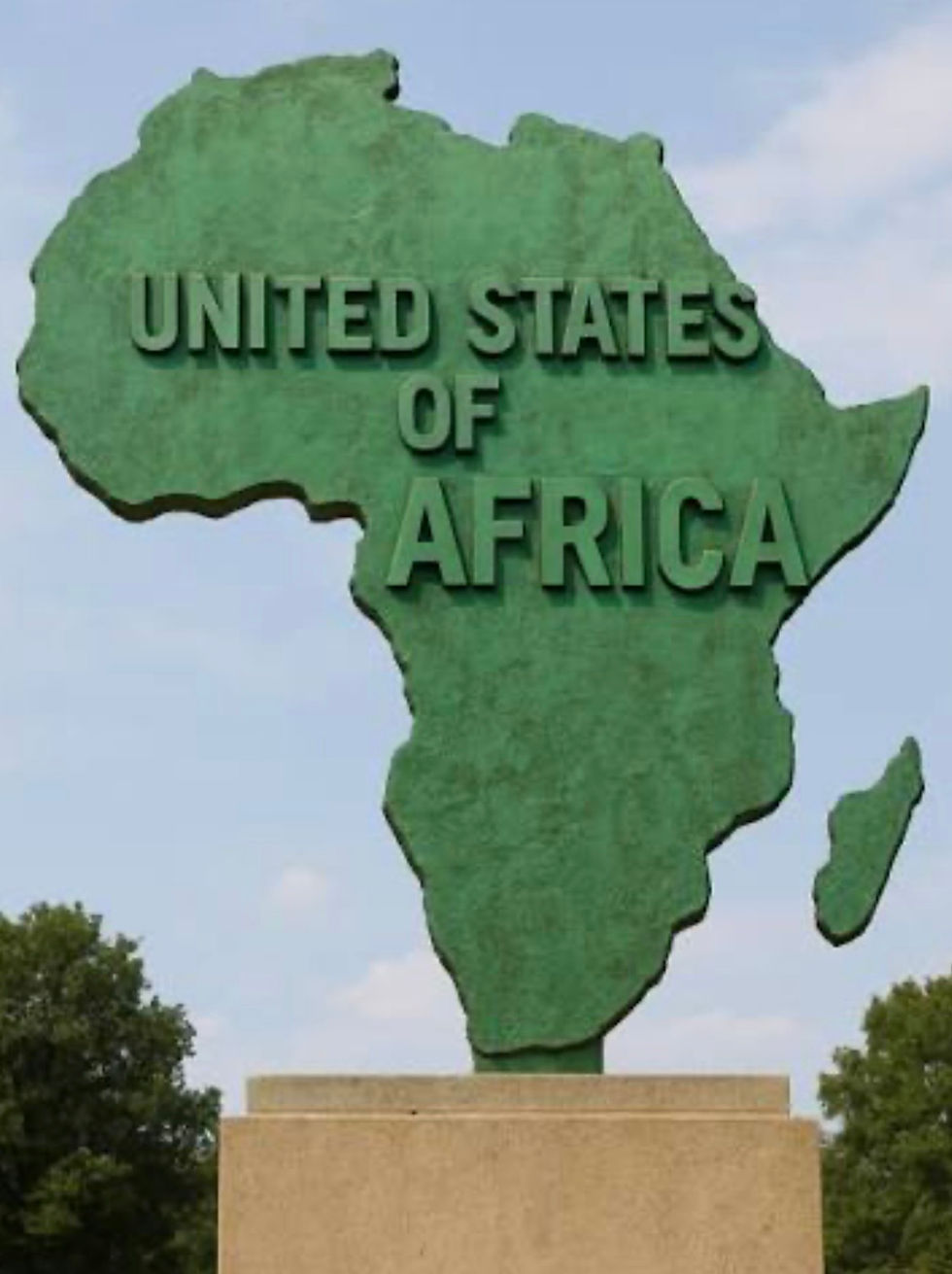
There was a time when Africa’s leaders dared to dream beyond the borders drawn by colonial powers. They did not imagine Africa as a fragmented collection of states separated by artificial lines on a map, but as one continent bound together by shared history, common humanity, and collective destiny. That vision lived in the voices of Kwame Nkrumah, Julius Nyerere, Patrice Lumumba, and Haile Selassie — leaders who believed that Africa’s true liberation would remain incomplete until Africans could unite politically, economically, socially, and culturally.
More than six decades after formal independence, however, many of the barriers created during colonial rule still shape the everyday realities of Africans. An African often faces more restrictions traveling within Africa than entering parts of Europe, Asia, or the Middle East. Trade between African countries remains unnecessarily difficult. Border bureaucracy continues to slow the movement of goods, talent, students, researchers, entrepreneurs, and workers across the continent.
Yet the dream of Pan-Africanism has not disappeared. It survives within the continuing aspiration for a more connected, cooperative, and integrated continent. It is within this context that the idea of Open Africa emerges — not simply as a slogan, but as both an initiative and a policy intervention aimed at opening Africa to Africans themselves.
Pan-Africanism was never merely an emotional political movement. It was a strategic vision for Africa’s future. Its pioneers understood that Africa’s strength could never be fully realized through fragmentation into small states divided by colonial systems designed primarily for administrative control rather than African unity. Many post-independence governments inherited borders that ignored historical communities, trade routes, languages, cultural relationships, and longstanding systems of interaction that existed long before colonial occupation.
As a result, borders that should function as bridges connecting African societies too often operate as barriers separating Africans from one another. Restrictive visa systems, inconsistent immigration procedures, customs bureaucracy, weak infrastructure, and fragmented regional systems continue to limit the continent’s economic and social potential.
Today, Africa possesses one of the world’s youngest populations, abundant natural resources, expanding markets, and enormous human potential. Yet the continent still struggles to function as a truly integrated economic and social space. Intra-African trade remains significantly lower than in Europe or Asia, while many African economies continue to trade more easily with external markets than with neighboring African countries.
The contradiction becomes even clearer when compared with other regions of the world.
In the United States, a citizen from Maryland does not require a visa to travel to New York, Texas, Oklahoma, or Michigan. Movement across states is treated as a normal expression of national unity and economic integration. Businesses operate across state lines, students pursue education freely, and labor mobility strengthens the broader national economy.
Africa, by contrast, still often treats African movement through the lens of suspicion, bureaucracy, and fragmentation.
Yet the conversation about African openness is more complex than simply removing borders overnight. Questions of security, governance, irregular migration, trafficking, and institutional capacity cannot be ignored.
Even within existing African unions, these tensions remain visible. In the United Republic of Tanzania, movement between Mainland Tanzania and Zanzibar does not operate as a traditional international visa system, since both belong to one republic. However, identity verification and immigration-style checkpoint procedures still exist, shaped partly by administrative arrangements, security concerns, and efforts to address issues such as human trafficking and exploitative labor movement.
Over the years, concerns have emerged regarding trafficking networks involving vulnerable girls and women moved from Mainland Tanzania through Zanzibar and onward to foreign labor markets under exploitative conditions. Such realities demonstrate that openness without governance safeguards can expose vulnerable populations to abuse and criminal exploitation.
This is why the future of African integration cannot be reduced to slogans about “open borders” alone. The real challenge is whether African states can build trusted systems that balance mobility with accountability, openness with security, and integration with the protection of human dignity.
Other regions have already demonstrated that openness does not eliminate governance controls. The United States maintains coordinated federal security systems while preserving free movement across states. Europe’s Schengen framework similarly combines mobility with shared security cooperation and border management structures. Africa’s challenge, therefore, is not whether movement should exist, but whether African institutions can cooperate effectively enough to make such movement safe, trusted, and beneficial for ordinary Africans.
In this sense, Open Africa should not be understood as the absence of regulation. Rather, it is the creation of smarter and more coordinated African systems capable of supporting freer movement while protecting sovereignty and vulnerable populations. This includes:
digital identity systems,
coordinated immigration frameworks,
anti-trafficking cooperation,
harmonized trade procedures,
labor mobility agreements,
regional security partnerships,
and investments in transportation and digital infrastructure that physically and economically connect African societies.
Importantly, Africa does not suffer from a lack of institutional frameworks. The African Union, the African Continental Free Trade Area (AfCFTA), the East African Community (EAC), ECOWAS, and SADC have already demonstrated that regional integration is both possible and beneficial. The challenge is no longer the absence of vision, but the inconsistency of implementation and political commitment.
The African Union itself must increasingly evolve beyond functioning primarily as a diplomatic gathering of states. It must become a practical instrument for African mobility, economic integration, continental citizenship, policy coordination, and shared development.
Africa cannot continue celebrating Pan-Africanism ceremonially in speeches, annual summits, and symbolic declarations while systems on the ground continue to divide Africans from one another.
The question is no longer whether African unity is desirable. The deeper question is whether African leadership is prepared to confront the political, institutional, and psychological barriers that continue to preserve fragmentation across the continent.
For Africa’s youth especially, the stakes are enormous. Millions of young Africans possess creativity, entrepreneurial ambition, technological talent, and educational aspirations that extend beyond national borders. Yet many still encounter visa barriers, bureaucratic restrictions, weak labor mobility systems, and limited opportunities for continental collaboration.
An Open Africa could transform this reality by creating broader educational exchanges, innovation ecosystems, cross-border entrepreneurship, regional labor opportunities, and stronger continental identity among younger generations.
A united Africa does not require the erasure of nations, cultures, or sovereignty. It requires building systems where Africans can move, trade, study, innovate, and collaborate across borders with greater trust, efficiency, and shared continental purpose.
Colonial powers divided Africa for administrative convenience and political control. Independent Africa now faces a historic responsibility: whether to preserve those divisions through policy inertia and fragmented governance, or to gradually build a continent more connected by cooperation than separated by borders.
Africa’s greatest resource is not only its minerals, land, or markets — it is the collective strength of its people. But that strength will remain constrained so long as Africans continue to encounter more barriers within Africa than opportunities beyond it.
The dream of a United Africa will remain incomplete so long as colonial borders continue to carry greater practical power than the Pan-African vision itself.
— WTM | Pan-Africanism, Governance & Continental Integration


Thanks for this building the future piece of writing