


When Liberation Memory Turns Against African Solidarity: South Africa, Xenophobia, and the Unfinished Question of African Unity!

Nia N. Kileo | Wisdom Thrives Media
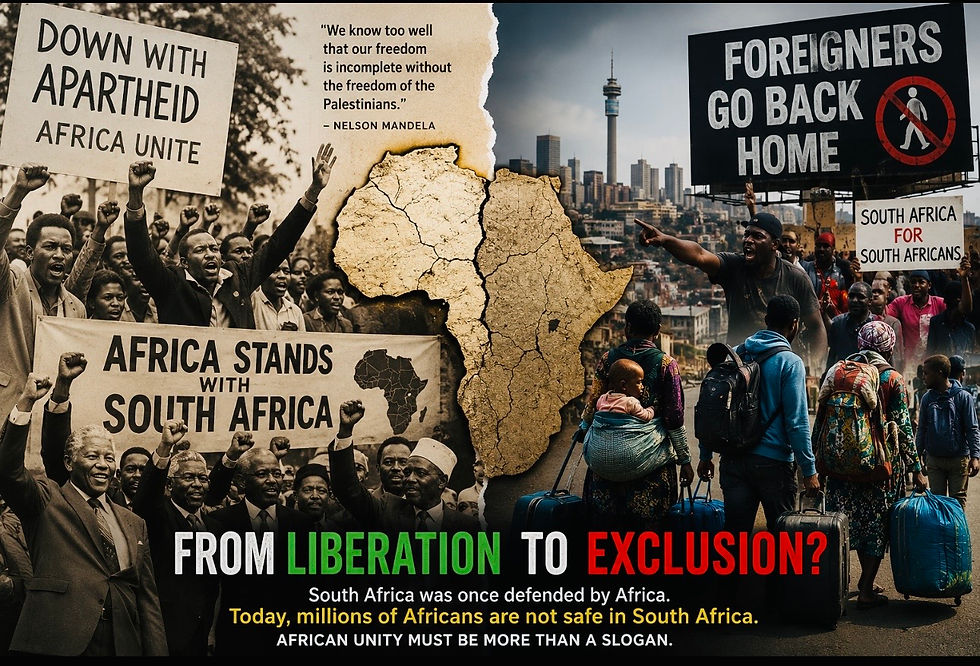
South Africa carries one of the most powerful moral histories on the African continent. For decades, apartheid made the country a global symbol of racial injustice, state cruelty, and human indignity. Across Africa and beyond, people rallied, protested, sacrificed, sheltered exiles, supported liberation movements, and paid political and economic costs because apartheid was not viewed as South Africa’s problem alone. It was treated as a wound against humanity.
That is why the current violence and hostility against African migrants in South Africa feels especially painful. It is not only an immigration crisis. It is a moral contradiction.
How can Africa continue chanting “African unity” when Africans cannot safely live, work, trade, study, or seek medical care among fellow Africans? How can a country whose freedom was defended by the continent now allow its most vulnerable frustrations to be redirected toward fellow Black Africans?
This is where South Africa’s present crisis becomes larger than South Africa. It exposes the gap between liberation memory and civic practice. It reveals that political freedom does not automatically produce moral maturity, social justice, or continental solidarity.
South Africa has legitimate domestic pressures: high unemployment, inequality, crime, weak public services, and concerns over undocumented migration. These realities cannot simply be dismissed. But no national frustration justifies mob justice, vigilante violence, denial of healthcare, harassment, or the humiliation of foreign nationals. When fellow Africans become convenient scapegoats for deeper structural failures, society begins turning its anger downward rather than addressing the root causes of its internal crisis.
That is not immigration enforcement. That is social cruelty wearing the mask of patriotism.
The tragedy is that South Africa once stood before the world asking to be seen beyond the racist logic of apartheid. It asked humanity to recognize Black South Africans as human beings — not as threats, burdens, criminals, or disposable bodies. Today, when foreign Africans are treated as invaders and blamed collectively for unemployment, crime, or social decay, South Africa risks reproducing the very logic it once fought tirelessly against: the logic of dehumanization and indignity.
This is where the comparison with Israel becomes morally sensitive, yet difficult to ignore. Israel emerged from one of history’s darkest chapters — the horrors of Nazism and the systematic persecution of Jews during the Holocaust. The world rallied around the principle that no people should ever again face extermination, humiliation, or denial of their humanity. Yet over the years, critics argue that the same state born from historical suffering has increasingly been accused of exerting overwhelming power over Palestinians through occupation, displacement, military force, and unequal systems of control.
The warning for South Africa is not about identical histories or political circumstances. It is about the danger of liberation memory losing its moral compass. A society that once fought oppression can, over time, begin rationalizing the suffering of others in the name of nationalism, frustration, insecurity, or historical entitlement. A nation can carry genuine wounds from its past while simultaneously inflicting wounds on others in the present.
That is the contradiction South Africa must guard against.
Because once a liberation struggle transforms into selective humanity, moral authority begins to erode. A country cannot endlessly invoke the pain of apartheid while ignoring the pain of fellow Africans being attacked, humiliated, or made to feel unwanted on South African soil. The world once stood with South Africa because apartheid violated the universal principle of human dignity. Xenophobia violates that same principle.
The African Union, SADC, and African leaders should not remain comfortable issuing routine condemnations after violence erupts. African unity cannot survive as a ceremonial slogan repeated at summits while ordinary Africans are hunted, threatened, or blamed in the streets of another African country. Unity must mean more than flags, speeches, and trade agreements. It must mean that Africans recognize each other’s humanity beyond borders.
A Zimbabwean, Nigerian, Malawian, Congolese, Mozambican, Kenyan, Tanzanian, or Ghanaian living in South Africa should not automatically become a symbol of public frustration or economic anxiety. Migration challenges are real across the world, but responsible states address such issues through law, policy, border management, regional cooperation, and economic reform — not through vigilante intimidation or collective hostility toward entire communities.
South Africa still possesses enormous moral influence globally because of its anti-apartheid legacy. But history alone cannot permanently protect a nation’s reputation. Moral credibility must continually be renewed through conduct.
The greater danger is not only violence itself. It is the normalization of a mindset where fellow Africans are increasingly viewed not as partners in a shared continental future, but as intruders whose suffering no longer matters. That mentality slowly destroys the very foundation upon which Pan-African solidarity was built.
Africa stood with South Africa because Africa believed that no people should ever be reduced to outsiders in the land where they seek dignity, survival, work, or safety. South Africa now faces its own moral test: whether it will preserve the human values that once inspired the world, or whether liberation memory will slowly give way to exclusion, resentment, and selective compassion.
African unity will not be proven through speeches.
It will be proven when Africans stop treating fellow Africans as disposable strangers.
WTM- Independent Media. Strategic Commentary. Civic Education. Principled Analysis.
Comments