


World Legacy Leaders: The Enduring Struggle for Justice, Peace, Freedom, and Human Dignity!
- Adveline Minja
- May 11
- 3 min read
By Nia N. Kileo | Wisdom Thrives Media
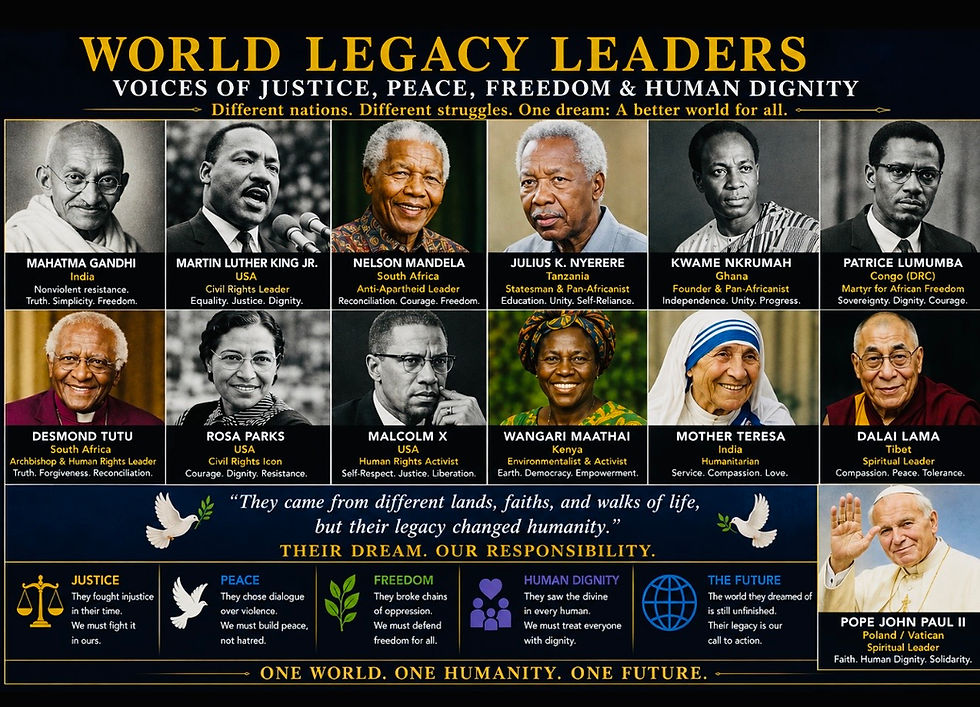
History does not remember leaders merely because they held power. Many ruled nations, commanded armies, controlled institutions, or occupied the highest offices of their time — yet disappeared into the margins of memory once their era ended. What separates enduring world legacy leaders from ordinary political figures is not authority alone, but the moral, social, and human impact they leave behind.
Across different continents, cultures, religions, and political systems, certain individuals emerged whose ideas and sacrifices transcended borders and generations. Some fought colonialism. Others resisted racism, dictatorship, oppression, poverty, or inequality. Some carried the language of peace and reconciliation; others challenged the conscience of the world by confronting injustice directly. Yet despite their differences, they shared one central belief: human dignity matters.
Figures such as Mahatma Gandhi, Martin Luther King Jr., Nelson Mandela, Julius Nyerere, Kwame Nkrumah, and Desmond Tutu did not simply influence their own countries. They shaped how the modern world understands freedom, justice, reconciliation, equality, and collective responsibility.
One of the defining characteristics of many world legacy leaders was their willingness to sacrifice personal comfort, safety, or political advantage for a broader moral cause. Gandhi transformed nonviolent resistance into a global political philosophy, proving that mass civil resistance could challenge imperial domination. Martin Luther King Jr. carried similar principles into the American civil rights movement, confronting segregation and racial injustice through peaceful protest and moral persuasion.
Their methods influenced movements far beyond India and the United States. The language of civil resistance, peaceful protest, and moral courage became part of global civic education itself.
In Africa, leaders such as Nyerere, Nkrumah, Patrice Lumumba, and Thomas Sankara became symbols of anti-colonial liberation and African self-determination. They believed political independence had little meaning if nations remained economically dependent, socially divided, or psychologically subordinate after colonial rule ended.
Nyerere, in particular, represented a model of leadership grounded in education, nation-building, Pan-African solidarity, and public ethics. Tanzania became a refuge for liberation movements across Southern Africa, reinforcing the idea that freedom struggles in one country were tied to the dignity of the African continent as a whole.
The global struggle for human dignity also expanded beyond politics alone. Leaders such as Mother Teresa, Wangari Maathai, and Dalai Lama demonstrated that justice is not only about governments or elections, but also about compassion, environmental stewardship, spiritual coexistence, and the protection of vulnerable communities.
Wangari Maathai, for example, connected environmental protection to democracy, women’s empowerment, and community survival long before climate justice became a global movement. Her work showed that the destruction of nature often mirrors the exploitation of people.
At the same time, figures such as Malcolm X and Steve Biko challenged societies to confront not only institutional oppression, but also psychological liberation and self-worth. Their legacy reminds the world that freedom is not simply political independence; it also involves identity, dignity, confidence, and belonging.
Importantly, many of these leaders were not universally loved during their lifetimes. Some were imprisoned. Some were assassinated. Others were dismissed as dangerous, unrealistic, divisive, or radical. Yet history often reevaluates moral leadership differently from immediate politics. Time tends to distinguish between those who merely pursued power and those who attempted to enlarge the moral imagination of society.
Modern societies continue to wrestle with inequality, conflict, authoritarianism, racial tensions, displacement, poverty, and growing global polarization. In such a world, remembering legacy leaders is not about hero worship or pretending they were flawless human beings. It is about civic memory.
Civic education matters because societies without historical memory often repeat the same injustices they once condemned. These leaders remind humanity that:
freedom requires responsibility,
justice requires courage,
peace requires restraint,
and human dignity requires recognizing the humanity of others even during disagreement.
Their legacy also warns against reducing leadership to fame, popularity, wealth, or political dominance. True historical influence is measured not only by how loudly a person ruled, but by what values continue to live after them.
Some built nations. Some built movements. Some built moral consciousness itself.
That is why decades after their deaths — and in some cases generations later — the world still studies their speeches, debates their ideas, teaches their philosophies, and invokes their names during moments of crisis and hope.
Because genuine legacy is not built merely on power.
It is built on what humanity becomes because they once lived.
Reflection question:
What kind of leadership does the modern world reward today––and what kind of leadership does humanity actually need?


Comments