


When Aid Becomes Political Pressure: Tanzania, the EU Parliament, and the Limits of External Influence!
- Adveline Minja

- May 13
- 3 min read
By Nia N. Kileo | Wisdom Thrives Media
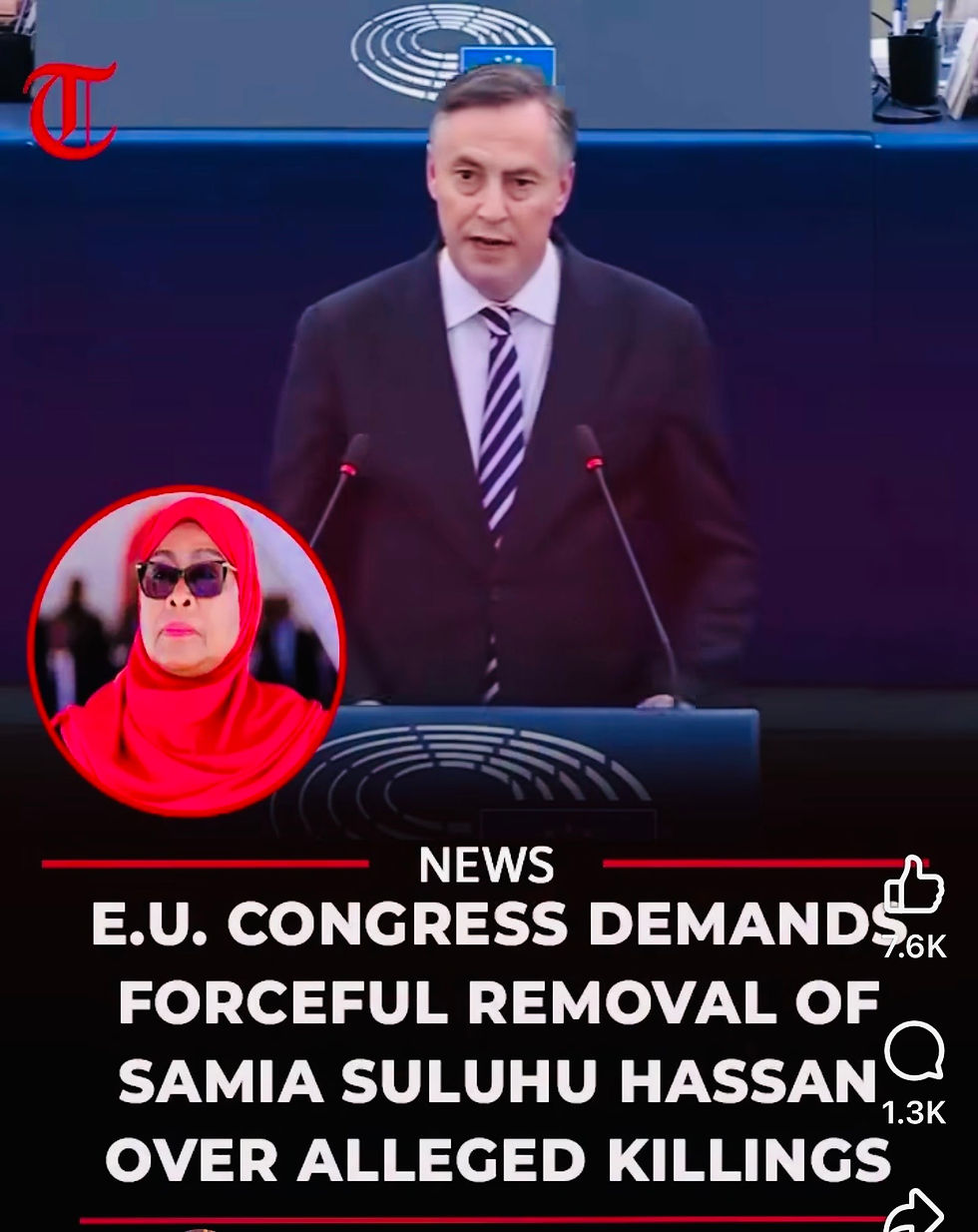
“Aid can be conditional. Sovereignty cannot be conditional”.
The European Parliament has the right to review, suspend, or withdraw its financial assistance to any country. Aid is voluntary, not compulsory. But what it does not possess is political authority over Tanzania’s sovereignty, leadership, constitutional order, or national direction. Those matters belong to Tanzanians alone.
For more than seven months after Tanzania’s 2025 election crisis, sections of the European political establishment have continued speaking about Tanzania in ways that increasingly resemble political supervision rather than diplomatic engagement. At some point, legitimate concern crosses into persistent interference. And when foreign legislators begin discussing how another sovereign state should govern itself, who should remain in power, or what political direction a nation should take, the conversation stops sounding like partnership and starts sounding like external pressure.
While the parliamentary clip itself is not new, its repeated circulation months later by activists and government critics raises an important question about political responsibility in fragile post-crisis environments. Nations recovering from periods of tension require space for stabilization, institutional recovery, and social calm — not the constant reactivation of emotionally charged narratives that keep societies psychologically tied to conflict long after the immediate crisis has passed.
That is precisely why many Africans remain deeply sensitive to this pattern. The continent’s historical experience with colonial powers was not merely military occupation. It was also the assumption that Europe possessed moral, political, and civilizational authority to decide what was best for Africans — often against the wishes, cultures, priorities, and sovereignty of African societies themselves.
Today, the language is different. The instruments are different. But many Africans increasingly observe the same underlying posture: aid attached to political obedience, diplomatic pressure framed as moral responsibility, and public lectures directed at African governments in ways rarely applied elsewhere with equal intensity.
A sovereign partnership cannot operate on superiority and subordination. It cannot function on the assumption that financial assistance gives one side the right to politically intimidate the other. If the European Union believes cooperation with Tanzania no longer aligns with its policies or values, it has every right to freeze aid, reassess programs, or reduce engagement. That is diplomacy. What becomes problematic is the growing tendency to weaponize aid as leverage over internal political affairs.
Such behavior does not strengthen democracy. It risks deepening polarization, resentment, instability, and mistrust between African nations and Western partners. Democracy is not built through external intimidation, nor can national stability emerge from foreign political pressure campaigns.
Tanzania, like every sovereign state, must resolve its internal matters through its own constitutional, institutional, and societal mechanisms. That does not mean nations are above criticism. It means criticism must respect the boundaries of sovereignty and avoid sliding into political engineering.
More importantly, this moment should serve as a wake-up call for Africa itself.
African nations cannot continue building systems that leave the continent perpetually vulnerable to external political pressure through aid dependency. If Africa desires genuine sovereignty, then economic, institutional, and regional self-strengthening must become a continental priority. Political independence without economic resilience leaves nations exposed to constant external influence.
This is why African cooperation matters now more than ever. The future stability of the continent may depend less on external approval and more on Africa’s ability to strengthen intra-African trade, regional financing mechanisms, strategic partnerships, industrial growth, food security, and collective diplomatic coordination.
Africa is not condemned to permanent dependency on former colonial powers. The continent today has broader global options, including expanding partnerships within Africa itself and with emerging global powers across Asia, the Middle East, and beyond. The goal should not be replacing one dependency with another, but creating balanced, mutually respectful relationships rooted in sovereignty and shared interests.
Ultimately, stable partnerships cannot survive on threats, pressure, or paternalism. They survive on mutual respect.
If Europe wishes to engage Africa as an equal partner in the 21st century, then it must move beyond the lingering mentality that African sovereignty remains subject to external political management.
And Africa, in turn, must recognize that sovereignty is not merely defended through speeches. It is secured through unity, institutional strength, economic independence, and the confidence to solve African challenges through African agency.


Comments